Genogram in family therapy: Bowen, examples and a free tool
The genogram in family therapy comes from Murray Bowen’s family systems work: a diagram of three or more generations that shows who is in the family and how they relate, used in family therapy and counseling. This page covers the genogram in family therapy as a drawing: the Bowen ideas it records, a fictional example with emotional lines, and how to draw a therapy genogram in a video session. Genogram Pro (genogram.pro) is a free genogram maker for this, with no account. It is a drawing tool; it does not interpret or diagnose.
Family therapy genogram example
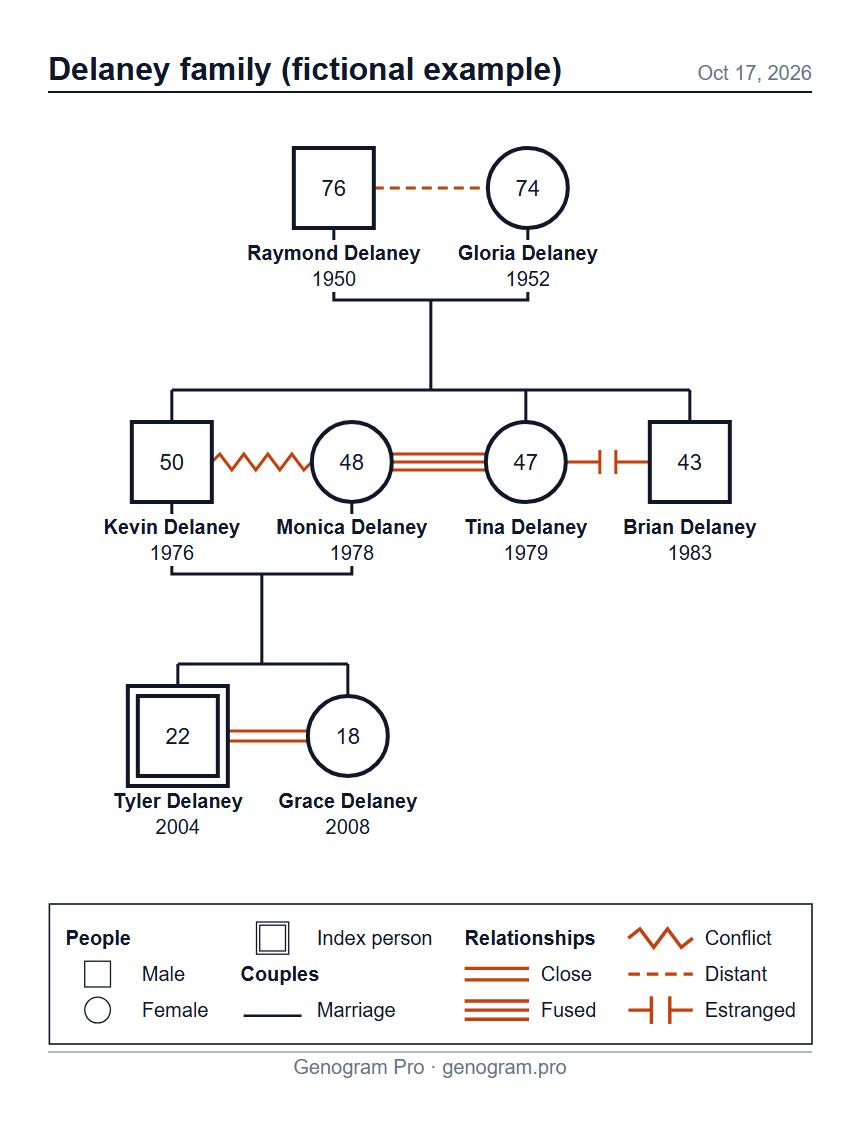
The family below is fictional: three generations of the Delaney family, with five emotional lines drawn over the structure. Each line type is named in the key beside the picture and on the PDF. Open it in the editor to try the lines, or start your own.
Genogram with emotional relationships
The same kind of family with its emotional relationships drawn over it: close, fused, distant, conflict and an estrangement (cutoff). The key on the PDF names each line type.
Text description of this genogram
Genogram: 8 people. Raymond Delaney, male, born 1950. Gloria Delaney, female, born 1952. Kevin Delaney, male, born 1976. Monica Delaney, female, born 1978. Tina Delaney, female, born 1979. Brian Delaney, male, born 1983. Tyler Delaney, male, born 2004, index person. Grace Delaney, female, born 2008. Couples: Raymond Delaney and Gloria Delaney (marriage); Kevin Delaney and Monica Delaney (marriage). Children: Kevin Delaney (biological child of Raymond Delaney and Gloria Delaney); Tina Delaney (biological child of Raymond Delaney and Gloria Delaney); Brian Delaney (biological child of Raymond Delaney and Gloria Delaney); Tyler Delaney (biological child of Kevin Delaney and Monica Delaney); Grace Delaney (biological child of Kevin Delaney and Monica Delaney). Relationships: Tyler Delaney and Grace Delaney (close); Kevin Delaney and Monica Delaney (conflict); Tina Delaney and Monica Delaney (fused); Tina Delaney and Brian Delaney (estranged); Raymond Delaney and Gloria Delaney (distant).
Bowen saw the family as an emotional unit, and the genogram became the standard way to draw one; McGoldrick, Gerson and Petry’s Genograms: Assessment and Treatment set the notation most courses teach. A family therapy genogram usually records:
Structure across generations: who married whom, divorces, children, deaths and losses, each in its place in birth order.
Patterns that repeat: the same kind of event or relationship in more than one generation is easier to see when the generations are drawn one above the other.
Triangles: three people whose relationships are tied together, drawn as the lines between each pair.
Emotional relationships: close, fused, distant, conflict and cutoff, each a line of its own between two people.
What these mean for a particular family is the therapist’s and the family’s work, not the drawing’s. The editor puts the lines where you say and names them in the key.
Drawing emotional lines without the mess
Emotional lines are where a hand-drawn genogram turns into squiggles. In Genogram Pro, select a person, press Link, pick the other person and choose the kind of relationship; there are 39 kinds, and an arrow can point from one person to the other. Lines are routed around other people and their names, and the layout rearranges itself after every change.
Hide every emotional line with one switch in Layers, or show only the selected person’s.
The export’s key lists only the line types on your genogram.
A genogram is hard to share over telehealth when it is on paper. In the browser it works like a whiteboard you both can see:
Open the editor before the session and share your screen (or just the browser tab) in your video app.
Add people as the client talks, or type a few sentences (with pseudonyms) into the AI chat and let it draft the family; it asks when a sentence can be read two ways.
Drag people where the client expects them; the diagram stays tidy as it grows.
After the session, export a PDF or PNG for your notes, de-identified if you prefer, or save the .genogram file to continue next time.
Without the cloud your genogram stays on your device; only what you type into the AI chat, and the family it edits, is sent to the AI provider. No account is needed to draw. The Professional cloud is not for identifiable client information.
Use pseudonyms and years only for clients: no real names, addresses or contact details.
The chat has a setting not to send notes to the AI.
De-identified export prints initials without dates.
Genogram Pro is not a HIPAA business associate and does not sign BAAs.